
In the first article, we looked at what “carrier-provided COBRA administration” typically includes—and where gaps can occur when responsibilities are unclear or handoffs are inconsistent. Here we address two more considerations employers and brokers should weigh before making a change: carrier transitions and the real meaning of “FREE” COBRA administration. We close with a practical checklist you can use at renewal or during a carrier change.
What If You Change Carriers Later?
This is an important consideration for fully insured groups. If COBRA administration is bundled with the carrier, a carrier change may also mean changes to COBRA workflows, billing, participant communications, enrollment processes, reporting, and recordkeeping.
A carrier change does not eliminate the need to properly administer continuation coverage (with appropriate record keeping) for qualified beneficiaries who are already in an election period, initial-payment period, grace period, or active COBRA coverage period. Employers should understand how the transition will work for those individuals and who will maintain historical records, answer participant questions, and communicate coverage changes.
Transition periods can create heightened administrative risk, especially for COBRA participants who are mid-election or mid-payment cycle. Before selecting carrier-provided COBRA administration, it is important to understand not only what is included today, but also what happens if the carrier changes in the future.
Looking Beyond “Free” COBRA Administration
When evaluating carrier-provided COBRA administration, cost is an understandable consideration. However, “free” does not always mean the same thing from one carrier or arrangement to another. The more useful question is not simply, “Is COBRA administration included?”

A Practical Employer and Broker Checklist
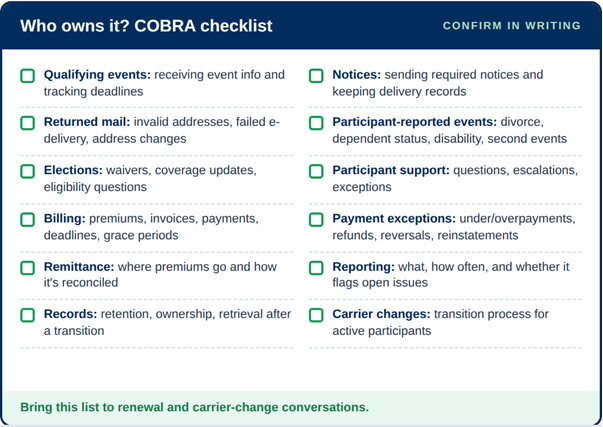
Before replacing a COBRA administrator, confirm—clearly and in writing—who is accountable for each of the following:
- Who receives qualifying-event information and tracks applicable deadlines.
- Who sends required COBRA notices and retains records showing when and how they were furnished.
- How returned mail, invalid addresses, failed electronic delivery, and participant address changes are handled.
- Who processes participant-reported events, such as divorce, legal separation, loss of dependent-child status, disability determinations, and second qualifying events.
- Who manages COBRA elections, waivers, coverage updates, and participant eligibility questions.
- Who handles participant questions, escalations, and administrative exceptions.
- Who calculates premiums, sends invoices, posts payments, and administers payment deadlines and grace periods.
- How underpayments, overpayments, refunds, retroactive elections, payment reversals, and reinstatements are handled.
- Whether premiums are remitted or reconciled to the employer, plan, carrier, or another designated party—and how that activity is tracked.
- What reporting is provided, how often it is delivered, and whether it allows the employer to identify unresolved issues.
- How long records are retained, who owns those records, and how they can be retrieved after a vendor or carrier transition.
- What the transition process is during a carrier change, particularly for active COBRA participants.
Broker tip: Add these questions to renewal and carrier-change checklists so COBRA administration does not become a last-minute issue.
The Bottom Line
Carrier-provided COBRA administration can be a workable option when responsibilities are clearly assigned and operational handoffs are well managed. Employers should look beyond whether a service is labeled “free” and confirm how the complete workflow will be handled in practice.
Before replacing a COBRA administrator, employers should ensure that every required administrative responsibility has a clear owner, a documented process, and a reliable recordkeeping method. The decision should be based on more than whether a service is included in a carrier arrangement; it should also account for the level of participant support, administrative visibility, billing oversight, documentation, and continuity the employer needs.
ITEDIUM supports clients by managing the day-to-day COBRA administration workflow and helping create a dependable administrative record from qualifying event through termination of coverage. For employers that value a dedicated administration partner, consistent processes, and support when exceptions occur, that level of service can be difficult to evaluate based on price alone.
State continuation coverage requirements may apply to employers or plans not subject to federal COBRA, and those requirements vary by state.