
We understand why employers ask this question—particularly fully insured employers evaluating carrier-provided COBRA administration. A carrier may offer to “handle COBRA,” and on the surface it can sound like one less vendor to manage. Before making a change, however, it is important to confirm what is included, what is not, and which responsibilities may shift back to the employer’s HR team or broker.
A carrier or other vendor may perform COBRA-related administrative functions, but outsourcing the work does not automatically transfer the employer’s compliance responsibility. Employers should confirm their plan’s designated plan administrator, each party’s responsibilities in writing, and the operational controls used to support notice, election, payment, and recordkeeping requirements.
At ITEDIUM, we usually see the COBRA workflow end-to-end: qualifying-event intake, notices, deadlines, elections, billing, participant support, documentation, and exception handling. If an employer moves away from a TPA model, the key question is not simply whether COBRA will be “handled.” It is whether every required step is assigned, monitored, documented, and supported when something does not go as planned.
What Does “Carrier-Provided COBRA Administration” Mean?
In practice, carrier involvement can vary widely. Carrier-provided COBRA administration may fall into one of these categories:
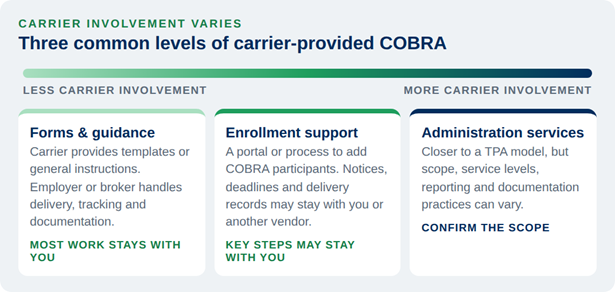
The most important takeaway: do not assume that “the carrier handles COBRA” means the carrier is performing every administrative and compliance-related function. Review the scope of work and responsibilities carefully. Ask your broker or carrier for a copy of their agreement or COBRA administration policy.
What a COBRA TPA May Handle
Depending on the service agreement, a COBRA TPA may provide an end-to-end administrative workflow that includes:
- Generating, furnishing, and retaining records for required COBRA notices, including general notices, election notices, notices of unavailability, and early-termination notices when applicable.
- Receiving qualifying-event information and monitoring applicable timelines.
- Managing COBRA elections, waivers, and eligibility updates.
- Billing premiums, posting payments, and administering the initial payment and ongoing payment grace periods.
- Managing terminations for nonpayment after applicable payment deadlines and grace periods have expired, including required participant communications when coverage terminates early.
- Handling participant questions, escalations, and administrative exceptions.
- Providing reporting and an audit trail ensuring the employer can understand what occurred and when.
- Supporting documentation gathering when a participant questions the process or submits a complaint, in coordination with the employer and, when appropriate, counsel.
- Reconciling premiums and remittances where applicable, including underpayments, overpayments, retroactive elections, refunds, and payment reversals.
- Evidence of notice furnishing. Employers should have copies or be able to reconstruct what was sent, when it was furnished, and to which last-known mailing address or authorized electronic delivery channel. If a participant later says, “I never received it,” reliable records can become central to evaluating and responding to the concern.
- Undeliverable notices. Returned mail and missing address updates can create risk when there is no documented follow-up process.
- Billing and payment handling. Misapplied payments, missed invoices, unclear due dates, or inconsistent handling of grace periods can create coverage problems and participant frustration—especially with retroactive elections.
- Participant support and escalations. When a participant is confused or upset, timely, consistent communication matters. Delays or conflicting messages can increase complaints and make issues harder to resolve. Are exceptions allowed? When? By whose authority?
- Documentation retention. When qualifying-event records, notices, payments, and participant communications are spread across multiple systems or vendors, reconstructing a timeline later can be difficult.
- Vendor handoffs. A carrier may manage enrollment while another party sends notices, bills participants, or responds to questions. Unless those handoffs are clearly defined and monitored, work can be duplicated—or missed.
This is the behind-the-scenes work that can reduce HR workload and help prevent small administrative issues from becoming participant disputes.
Where Gaps Can Occur
Most COBRA administration issues do not result from having no process at all. They arise when responsibilities are unclear, handoffs are inconsistent, deadlines are not actively monitored, or documentation is difficult to retrieve.
Common gap areas include:
- Evidence of notice furnishing. Employers should have copies or be able to reconstruct what was sent, when it was furnished, and to which last-known mailing address or authorized electronic delivery channel. If a participant later says, “I never received it,” reliable records can become central to evaluating and responding to the concern.
- Undeliverable notices. Returned mail and missing address updates can create risk when there is no documented follow-up process.
- Billing and payment handling. Misapplied payments, missed invoices, unclear due dates, or inconsistent handling of grace periods can create coverage problems and participant frustration—especially with retroactive elections.
- Participant support and escalations. When a participant is confused or upset, timely, consistent communication matters. Delays or conflicting messages can increase complaints and make issues harder to resolve. Are exceptions allowed? When? By whose authority?
- Documentation retention. When qualifying-event records, notices, payments, and participant communications are spread across multiple systems or vendors, reconstructing a timeline later can be difficult.
- Vendor handoffs. A carrier may manage enrollment while another party sends notices, bills participants, or responds to questions. Unless those handoffs are clearly defined and monitored, work can be duplicated—or missed.